
Why this lesson matters
Your base class and Ascendancy are the biggest build-shaping choices you make early on — bigger than any single passive node. Get the class right for your intended weapon and playstyle, and the passive tree (see The passive tree, dual specialization, and respec) does the rest of the work for you.
How class and Ascendancy selection works
You pick one of the 8 currently released base classes at character creation. Each class starts with a fixed attribute distribution and a primary weapon identity, though nothing stops you from branching out later via the shared passive tree. Partway through the campaign — Trial of the Sekhemas in Act 2, Trial of Chaos in Act 3, same trials for every class (see Primary attributes, defenses, Spirit, and controls) — you choose one of that class's Ascendancy sub-classes. Each class has up to 3 Ascendancies; you pick exactly one per character. The two trials aren't a two-step unlock sequence for this choice, either — clearing *either one first* unlocks your Ascendancy pick immediately; the other trial (and repeat runs of both at higher difficulty) just keeps feeding the same shared point total afterward.
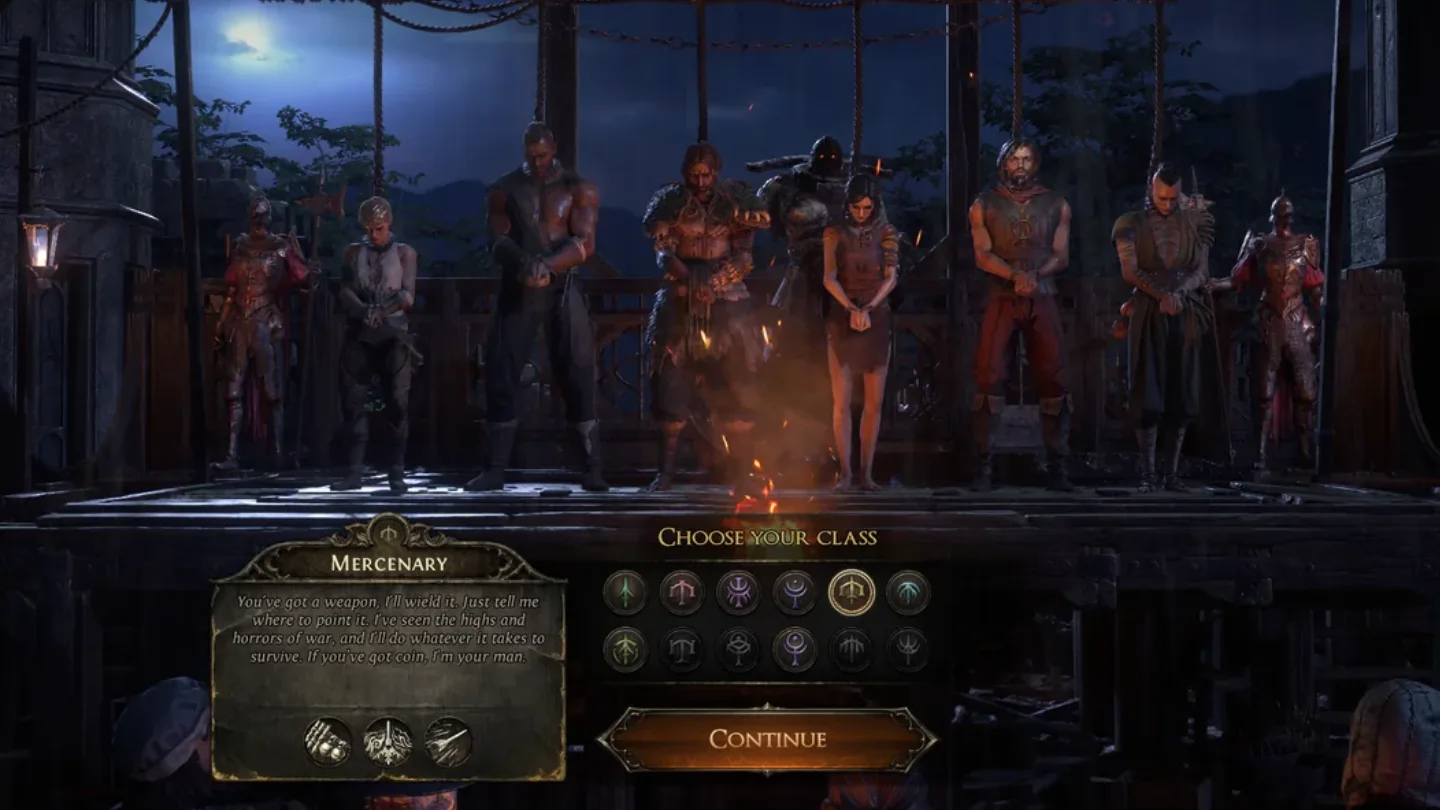
GGG's stated eventual target is 12 total base classes. 8 are released; the remaining 4 — Duelist, Marauder, Shadow, and Templar — are confirmed as planned but not yet released. (If you've seen a claim that it's 6 more classes rather than 4, that's wrong — it's 4, and no other names beyond those are currently confirmed.)
Your Ascendancy choice isn't fully permanent. You can switch to a *different Ascendancy of the same base class* later — for example, a Ranger going from Pathfinder to Deadeye. The process: refund your Ascendancy points with Gold at The Hooded One, then re-run the matching trial and choose differently at the Altar of Ascension. You cannot switch to a different base class's Ascendancy this way (a Ranger can't become a Huntress) — this only moves you between the 2–3 Ascendancy options within your original class.
One relationship worth stating plainly: a class's starting attributes don't restrict which of its Ascendancies you can pick. All three (or two, where a slot is unrevealed) Ascendancies are available regardless of your starting spread — the attributes just describe your class's default lean, not a requirement gating specific Ascendancy choices. A Warrior can pick Smith of Kitava despite it being less Strength-focused than Titan; nothing in the class-creation attributes locks that out.
The 8 base classes
Warrior — Strength, Maces & Shields **Starting attributes:** 15 STR / 7 DEX / 7 INT
Titan
Armor-scaling slam build. Gains a large Armor bonus from equipped Body Armour, empowers every second slam attack, triggers aftershock explosions, and inflicts a heavy stun (Crushing Blow) on primed enemies.
Warbringer
Totem and Warcry specialist. Totems act as aggro draws and damage buffers for the player rather than literal damage-redirection, paired with Warcry-based crowd control and enemy debuffing.
Smith of Kitava
A crafting-focused Ascendancy: restricted to a Normal (unmodified) Body Armour, but unlocks a set of skills that enchant that one armor piece directly with fire-infused effects. Built around your crafting choices rather than stat-stacking.
Ranger — Dexterity, Bows **Starting attributes:** 7 STR / 15 DEX / 7 INT
Deadeye
Frenzy Charge and projectile specialist, with distance-based damage scaling that rewards kiting and long sightlines.
Pathfinder
Flask and poison/concoction specialist, with bonus flask charges and a concoction-throwing skill that consumes flask charges instead of a normal skill cost; poison spreads between enemies.
**Third Ascendancy
still unrevealed.** As of patch 0.5.4, GGG has not shipped Ranger's third Ascendancy (other classes, like Huntress and Monk, received their third slot during 0.5.0; Ranger was not among them). Don't plan a build around a specific third option.
Witch — Intelligence, Wands & Minions **Starting attributes:** 7 STR / 7 DEX / 15 INT
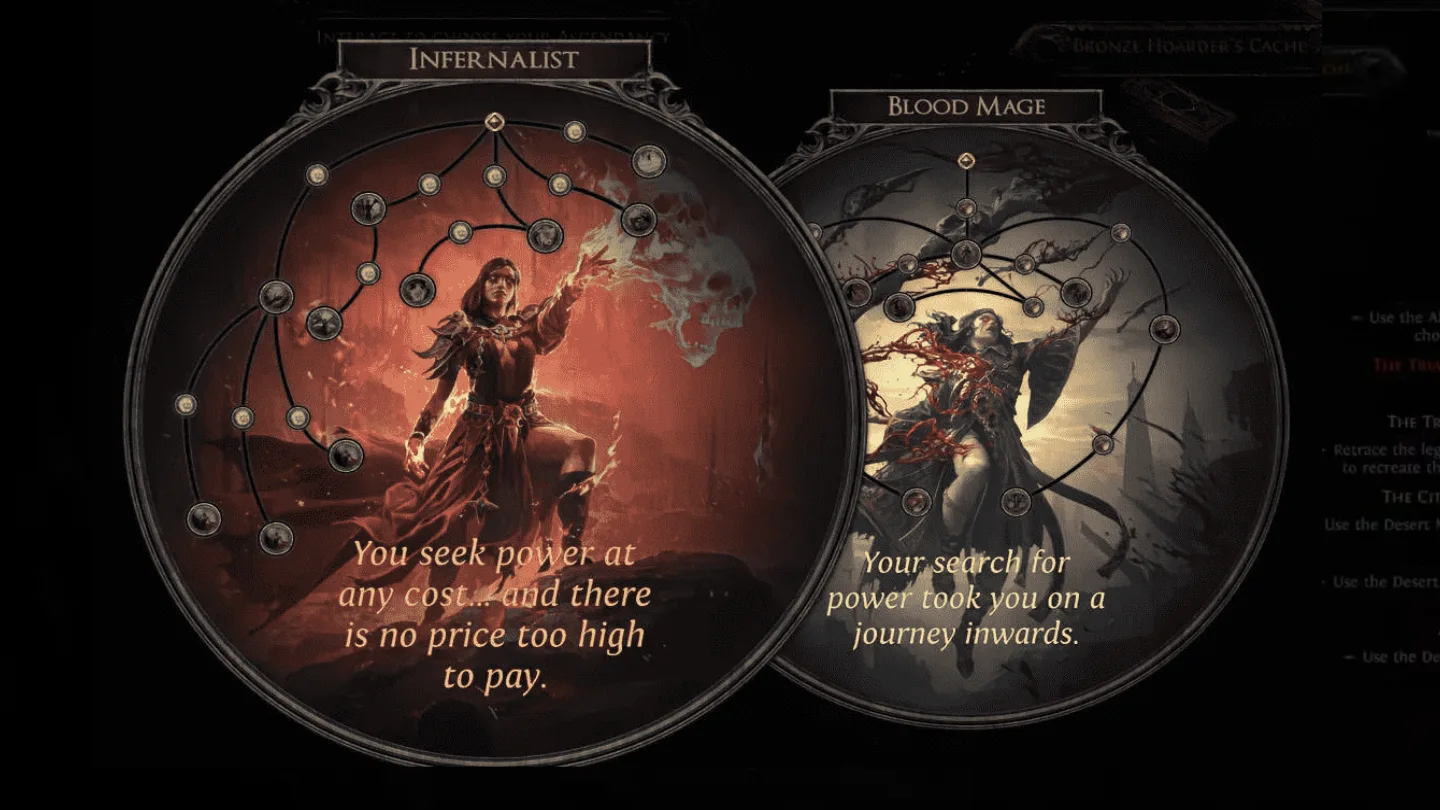
Infernalist
Demonic fire caster with a summoned Infernal Hound minion, and a choice between two resource-risk playstyles for scaling spell damage.
Blood Mage
Pays Life alongside Mana for skills, gets spell leech and life-restoring "Life Remnants" on kill, and converts Energy Shield into an offensive resource.
Lich
Curse and chaos specialist. Extra simultaneous curse with infinite duration, Unholy Might for you and nearby allies, on-kill chaos explosions, and Energy Shield spent as an offensive resource.
Sorceress — Intelligence, Staves **Starting attributes:** 7 STR / 7 DEX / 15 INT
Stormweaver
Elemental crit specialist that can stack dual Shocks simultaneously (rather than the usual single-Shock model), scaling crit damage off Mana/Arcane stacking.
Chronomancer
Time-control specialist: temporarily freezes time, reverses time on the player, and manipulates cooldowns.
Disciple of Varashta
Officially revealed. A djinn-summoning Ascendancy tied to three distinct djinn: one fire-damage focused, one a crit/assassination specialist, and one built around mana and Energy Shield recovery.
Monk — Dexterity/Intelligence, Quarterstaves **Starting attributes:** 7 STR / 11 DEX / 11 INT
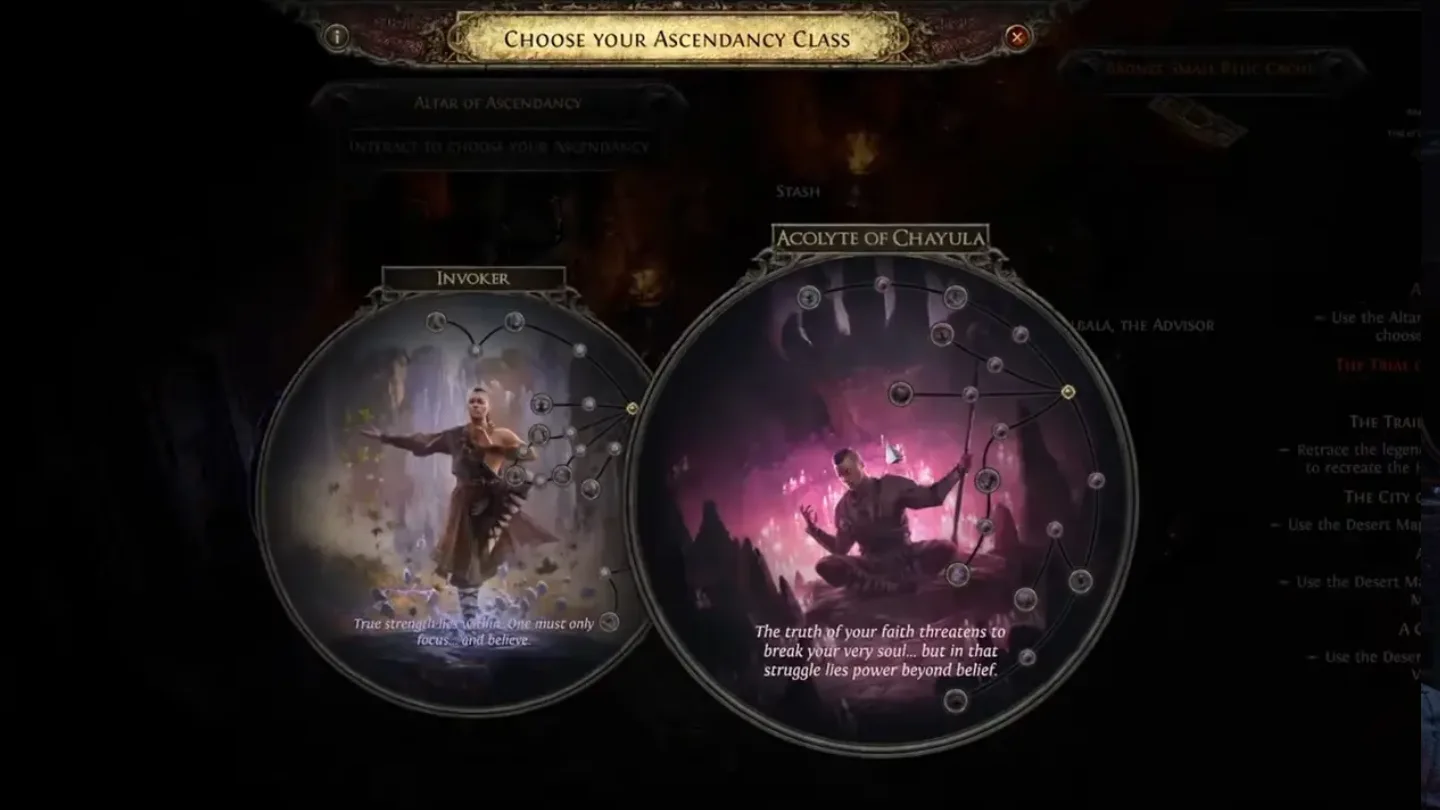
Invoker
Elemental-force specialist. Generates Spirit from equipped Body Armour's Energy Shield and Evasion rather than dedicated Spirit sources, layers extra Cold and Lightning damage with matching Chill/Shock synergies, and can overcap Energy Shield well past normal via the channeled skill Meditate.
Acolyte of Chayula
Replaces the Spirit resource entirely with "Darkness" (damage reserved from Darkness before Life/Energy Shield), doubles Chaos Resistance, and builds around Chaos-damage conversion plus summoned "Flames of Chayula" companions.
Martial Artist
Unarmed/hand-to-hand combat specialist. Way of the Stonefist turns your Gloves into Fists of Stone; the rest of the tree is stance, meridian, and hollow-bell notables. Tempest Bell is a general Monk skill some builds pair with, not granted here. Hollow Palm Technique is a shared-tree keystone, not a Martial Artist notable.
Mercenary — Strength/Dexterity, Crossbows & Grenades **Starting attributes:** 11 STR / 11 DEX / 7 INT
Witchhunter
Tracks a resource called Concentration on enemies, breaking it with Hits to unlock a burst-damage window (No Mercy scales damage off how much Concentration a target is missing), while a second branch grants Sorcery Ward — a Barrier that absorbs Elemental (and, further into the tree, Physical/Chaos) damage before your Life, Mana, or Energy Shield — traded for a cut of your natural Armour and Evasion.
Gemling Legionnaire
Gem-and-Attribute specialist: stacking Strength/Dexterity/Intelligence feeds a passive Barrier (Virtuous Barrier) built from Motes of each Attribute, a second branch frees Gems from their Attribute requirements entirely, and a third scales Skills off Support Gem colour and socket count. Enhanced Effectiveness: 20% less Attributes, but inherent Attribute bonuses are doubled. Skill Gem Quality comes from three +2% passives plus Advanced Thaumaturgy.
Tactician
Ally-support and positioning specialist: places Banners, buffs nearby allies' damage, and unlocks a personal grenade/artillery skill (Supporting Fire, granted by Unleash Hell!).
Huntress — Dexterity, Spears **Starting attributes:** 7 STR / 15 DEX / 7 INT
Amazon
Accuracy-and-Critical-Hit specialist: converts overflow Hit Chance past 100% into Critical Hit Chance, reveals and exploits Open Weakness on Rare and Unique enemies, and leeches from Elemental damage as well as Physical.
Ritualist
Corpse-sacrifice and jewelry specialist: can sacrifice a Rare monster's corpse (or spend your own Life instead) to gain a Monster Modifier, gains an extra Ring Slot, and recovers Life faster the more of it is missing.
Spirit Walker
Companion specialist built around three animal spirits: a Stag fed by movement, an Owl fed by time and spent on Dodge Roll, and a Bear summoned as a standing companion. This was Huntress's third Ascendancy slot, added in patch 0.5.0 ("Runes of Aldur") — all three Huntress Ascendancies are confirmed and live as of 0.5.4.
Druid — Strength/Intelligence, Sceptres & Shapeshifting **Starting attributes:** 11 STR / 7 DEX / 11 INT
Oracle
Fate-and-Critical-Hit specialist: inflicts Unlucky rolls on enemies trying to crit or hit you, keeps Totems fighting for six extra seconds past 0 Life, and builds toward a self-cast Visage system (Align Fate) that empowers your next matching Spell.
Shaman
Rage-and-elemental-adaptation specialist: builds Spirit off your empty Charm slots, strips Rage's normal decay for a steady per-second regen at a small cost tax on Skills, and turns incoming Elemental damage into a stacking resistance buff the more distinct Elements you've been hit by. Bringer of the Apocalypse caps the tree with a Glory-fueled skill that unleashes randomized elemental disasters. Shapeshifting is a Druid class feature, not a Shaman-only mechanic.
**Third Ascendancy
still unrevealed.** As of patch 0.5.4, Druid has shipped with only Oracle and Shaman. Don't plan a build around a specific third option.
Roster at a glance
| Base Class | Starting Attributes (STR/DEX/INT) | Weapon Identity | Ascendancies |
|---|---|---|---|
| Warrior | 15/7/7 | Maces, Shields | Titan · Warbringer · Smith of Kitava |
| Ranger | 7/15/7 | Bows | Deadeye · Pathfinder · *unrevealed* |
| Witch | 7/7/15 | Wands, Minions | Infernalist · Blood Mage · Lich |
| Sorceress | 7/7/15 | Staves | Stormweaver · Chronomancer · Disciple of Varashta |
| Monk | 7/11/11 | Quarterstaves | Invoker · Acolyte of Chayula · Martial Artist |
| Mercenary | 11/11/7 | Crossbows, Grenades | Witchhunter · Gemling Legionnaire · Tactician |
| Huntress | 7/15/7 | Spears | Amazon · Ritualist · Spirit Walker |
| Druid | 11/7/11 | Sceptres, Shapeshifting | Oracle · Shaman · *unrevealed* |
Practical tips
- Two classes — Ranger and Druid — still have one unrevealed Ascendancy slot. Don't plan a long-term build around a specific third option for either.
- Ascendancy choice isn't a one-way door within your class: if Pathfinder isn't working out on your Ranger, Deadeye is a Gold-and-a-trial-rerun away, not a reroll.
- Full notable breakdowns for Mercenary, Huntress, and Druid (and the other classes) live on the linked Ascendancy pages.
- If you're reading older POE2 content and see Ascendancy names like Slayer, Elementalist, or Inquisitor, that's Path of Exile 1 terminology mistakenly applied to POE2 — none of those exist here.
Sources: Maxroll — Class Overview · Maxroll — Ascendancy Overview · Maxroll — Lich Ascendancy Overview · PoE-Vault — Classes & Ascendancy Overview · PoE-Vault — Disciple of Varashta Reveal · Mobalytics — Respec Ascendancy Guide · Mobalytics — Classes Breakdown · VULKK — Spirit Walker Huntress Ascendancy · Fextralife — Ascendancies · Fextralife — Monk · Fextralife — Gemling Legionnaire · Game8 — Lich Ascendancy Overview and Skills · allthings.how — Martial Artist: Every Node and Passive Explained · GameRant — All Class Ascendancies